
Preparing For Physical Assessments
It is strongly recommended that you consult a physician before undertaking any new physical training program.
There are links at the bottom of this page for workout descriptions, workout calendars, and workout schedules.
Overview
Fitness tests differ from state to state. It is strongly recommended to review the website for further information on specific tests. Below is a breakdown of the particular tests with links to police agencies.
Many Police Services use the Beep Test to assess cardiovascular fitness.
In order to help you understand the requirements better. We have provided a link on our Public Samples page that will allow you to download a sample of the Beep Test audio file.
Link to Audio Beep Test
Australia Federal Police
Link to Australia Federal Police
Applicants for the Australia Federal Police will be required to participate in the Physical Competency Assessment (PCA). The following components will be tested.
Flexibility - Sit and Reach or Hip Flexion Test
The participant is measured on his or her ability to reach beyond their toes while seated with their legs straight. The Hip Flexion Test measures a participants ability to raise their leg in a straightened position while their other leg remains on the ground.
Aerobic Capacity - Multi-Stage Shuttle Run (Beep Test)
See information below for a more thurough description.
Strength Capacity
- Push Up Test
- Grip Strength
- Phased Sit-Up Test and Sit-Ups with Feed Held
Agility - Illinois Agility Test
This is a timed test sprinting back and forth between lines and zigzagging around cones.
New South Wales Police
Link to NSW Police
You must pass each of the following tests and achieve a total of 44 / 110 marks for entry into ADPP.
1) Handgrip Strength
This tests both left and right hands ability to squeeze a dynamometer exerting maximum force. You must score above 30 kg per hand.
2) Sit and Reach
The participant is measured on his or her ability to reach beyond their toes while seated with their legs straight. The participant is not permitted to stretch or warm-up prior to this test.
3) Vertical Jump
The participant is measured on their ability to jump vertically.
4) Abdominal Strenght Test
The participant must progress through 5 levels of sit-ups.
5) Push-Ups
Particpants are required to perform push-ups.
6) Illinois Agility Test
This is a timed test sprinting back and forth between lines and zigzagging around cones.
7) Metre Sprint
The participant is required to sprint a distance of 40 metres.
8) Multi-Stage Fitness (Shuttle Run or Beep Test)
SSee information below for a more thorough description.
Queensland Police
Link to Queensland Police
Queensland requires a Multi-Stage Fitness (Shuttle Run or Beep Test). See information below for a more thorough description.
Tasmania Police
Link to Tasmania Police
The Tasmania Police test their applicants based on the following criteria.
Body Mass Index
This is a measure of a candidates percentage body fat.
Strength and Endurance Tests
- Push-ups (maximum # in 60 seconds)
- Chin-ups (women require 1, men require between 6 and 8 depending on age)
- Handgrip Test
- 5 Stage Sit-Up Test
- Partial Curl-Ups
Flexibility
- Sit and Reach Test
- Shoulder Over and Under Test
Aerobic Capacity - Multi-Stage Shuttle Run (Beep Test)
See information below for a more thorough description.
Western Australia Police
Link to Western Australia Police
Western Australia breaks its fitness test into two components.
Part 1
- Abdominal Strength Training - only 1 specific sit-up required
- Firearm Pre Selection Criteria - continuously dry fire a police-issue firearm.
- Crowd Control Simulation - Operate a push-pull machine while swinging a weight in 180 degree arcs
- Shuttle Run (Beep Test) see information below
Part 2 - Obstacle Circuit
This assessment is conducted over a distance of 200 metres and contains:
- traversing a balance beam
- Jumping a 1.5 metre gully
- Leaping two obstacles 50 cms high approximately 4 metres apart
- Climbing a 1.5 metre super six type fence
- Scaling a 2.8 metre cyclone wire fence
- Lifting and carrying 40 kg weight 15 metres and placing it in the rear of a van
There is no minimum time, but the faster an applicant completes the test, the better his or her score.
South Australia Police
Link to South Australia Police
The South Australia Police Service measures the following areas.
Multi Stage Shuttle Run See information below about the Shuttle Run.
Agility Test
The agility test consists of an obstacle course involving the following components. The test must be completed in 3.5 minutes.
1) You begin inside a police vehicle.
2) Climb over a 1 metre mesh fence.
3) Climb over a 1.5 metre colour-bond fence.
4) Climb over a 3 metre Cyclone fence.
5) Climb over 1 metre barbed wire fence.
6) Crawl through a hole.
7) Leap over a 1.5 metre ditch.
8) Run through a simulated car park.
9) Climb over two 1 metre hurdles.
10) Climb through a window.
11) Drag a simulated body 20 metres.
12) Run 120 metres.
13) Remove a tire from the boot of a vehicle and put it down. Lift another tire and carry it back to the boot of the vehicle and place the tire inside the boot.
14) Fire a de-activated Model 19 double action revolver 6 times in each hand (total of 12 times).
Skin Fold Test (BMI)
Males must have less than 20% body fat and females must have less than 30% body fat.
Victoria Police
Link to Victoria Police
You will undergo the following four tests during your fitness evaluaiton with the Victoria Police Service.
1. Handgrip dynamometer test
This test will measure your grip strength. You will be required to squeeze a hand dynanometer for about three seconds in each hand (dominant hand first). This test correlates with general muscular strength. An instructor will be supervising the test and giving instructions.
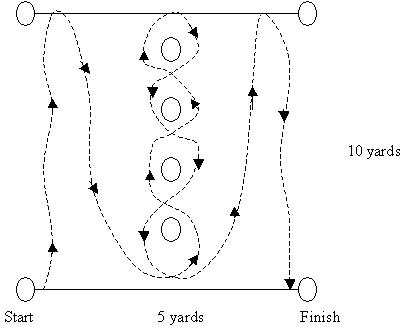
2. The Illinois agility run
This test requies you to run around a 9.14 metre (10 yards) x 4.16 metre (5 yards) course of cones as quickly as possible. To begin the test, lie on your front with your head at the start line and hands by your shoulders. When you start the test you get up as quickly as possible and run in the direction indicated without knocking over any cones. This will measure your speed and agility.
3. The 15 metre 75 kg dummy drag
This test requires you to stand behind a dummy, hold it under its arms and then drag the dummy in a straight line for 15 metres. This test measures core body strength and endurance.
4. The multi-stage fitness test
The Aerobic Fitness Test requires the completion of the 20-metre Shuttle Run, which is designed to evaluate aerobic fitness and work capability during physically demanding policing tasks as well as everyday policing activities.
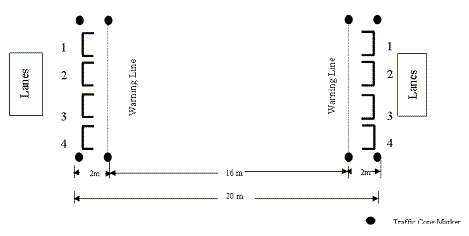
In this test, you run back and forth between two marked lines over a 20-metre course in time with taped audio signals. The time permitted at the beginning of the test to cover the 20-metre distance requires a slow jog. At the start you wil have 60 seconds to complete seven runs, followed by level two which is eight runs per minute, and so on. Thereafter, for each 20-metres, the time between audio signals lessens, requiring that you pick up your running pace. The audio signal informs you of the “stage” you are at as the test progresses.
In each leg of the shuttle run, warning lines, placed 2 metres before each of the 20-metre end lines, must be reached before the permitted time elapses and the audio signal sounds. An examiner will caution you if you fail to cross a warning line in time. The test ends when you miss two consecutive warning lines.
Strategy for the Shuttle Run
While performing the shuttle run it is important to pace yourself at the beginning. The early stages of the test can be completed with a quick walk. It is best to pace yourself so that as you reach the opposite side, you can immediately turn around and return the other way. As the pace of the tones increases, increase the pace of your run. This will give your muscles a chance to warm-up.
In order to help you understand the requirements better. We have provided a link on our Public Samples page that will allow you to download a sample of the Beep Test audio file.
Link to Audio Beep Test
It would be a mistake and increase your fatigue, thereby lowering your score if you sprinted in the early stages of the test, and had to wait for the return signal.
New Zealand Police
Link to New Zealand Police
You will be tested on four elements including:
1) 2.4 km run
Male requirements:
Under 20 years of age: 10 min 51 seconds
20 - 29 years: 10 min 15 seconds
30 - 34 years: 10 min 50 seconds
35 - 39 years: 11 min 30 seconds
40 + years: 12 min 15 seconds
Female requirements:
Under 20 years of age: 12 min 54 seconds
20 - 29 years: 11 min 50 seconds
30 - 34 years: 12 min 25 seconds
35 - 39 years: 13 min 10 seconds
40 + years: 14 min 10 seconds
2) Vertical Jump
Males: 48 cm
Females: 40 cm
3) Continuous Press Ups
Males: 34 or more
Females: 20 or more
4) Grip Strength Test
This test determines your grip strength which ensures you have the forearm strength to operate firearms and to restrain handcuff people.
Male: 95 kg
Female: 52 kg
BMI data will be captured, and used in conjunction with a waist to hip ratio to advise applicants of programs to undertake weight reduction and therefore increase both health and fitness levels if required.
Swimming Requirements
Applicants need to be able to pass a swimming test comprising:
- Swimming 50 metres in 54 seconds
- Treading water for 5 minutes
- Diving 3 metres to retrieve a rubber brick.
Candidates who are undertaking their testing in Aukland must have obtained their swimming certificate before they attend testing day.
Preparing for the Physical Pursuit Course
The following information pertains to the different exercises found in the suggested 6-week exercise regime. Since the Physical Pursuit Course tests several components of an individual’s physical fitness, the exercise regime contains a variety of different exercises and activities designed to improve aerobic and anaerobic capacity in conjunction with muscular strength, endurance and flexibility of the shoulders, arms, back and legs.
Aerobic Fitness
Aerobic fitness can be defined as the body’s ability to generate energy for working muscles during sustained exercise. This is done through a constant flow of oxygen into your lungs, which can be delivered to your muscles by your heart at a uniform, comfortable rate. In order to improve aerobic fitness, you must consistently challenge your body’s oxygen transport system. In other words, challenging your body’s oxygen transport system teaches your body to utilize oxygen more efficiently. The more efficient your body is at delivering oxygen to your working muscles, the fitter you are.
Improvements in aerobic fitness are gained through exercising at an appropriate frequency, intensity, and duration.
| Frequency | 3-5 times per week |
| Duration |
3 days a week - exercise should last for 50 - 60 minutes
5 days a week - exercise should last for 30 - 40 minutes
|
| Intensity | In order to gauge training intensity the best method is to monitor your heart rate. You must learn to efficiently take your pulse or use a heart rate monitor. When taking a pulse, calculate the amount of times your heart beats in a 10-second period. Next, take this number and multiply it by 6. This will indicate your heart rate for a 1-minute interval of time.
|
Maximal aerobic gains occur when working at approximately 80% of your maximum heart rate. In order to calculate your target heart rate, or intensity of exercise, use the following formula:
|
(220-age) x 0.80 (80%)
|
|
Example: The target heart rate for a 25-year old individual would be:
|
|
(220-25) x 0.80 = 156 beats per minute
|
This indicates to you that in order to improve aerobic fitness, the individual would have to ensure exercise was occurring at or above a target heart rate of 156 beats per minute for the full duration of the exercise.
Type of Exercise – To improve aerobic fitness, the exercise training must involve large muscle activity such as:
- running
- cycling
- swimming
- cross-country skiing
or active sports such as:
- basketball
- soccer
- squash
- badminton
Since the Physical Pursuit Course requires the completion of an aerobic run, the exercise program provided focuses specifically on running.
Anaerobic Training
As the name implies, anaerobic means “in the absence of oxygen”. Unlike the aerobic system, which requires oxygen to produce and transport energy, the anaerobic system uses the fuel stored in your muscles. Day to day, your body gets its energy from a variety of aerobic and anaerobic sources. The more intense the activity and the more your body’s demand for oxygen exceeds your ability to supply it, the more you work anaerobically. Depending on how fit you are, your anaerobic energy supply will last anywhere from 5 to 60 seconds. This is why anaerobic activities are usually activities that require highly intense, short bursts of energy.
An effective way to train the anaerobic system is through interval training, relatively short bursts of high to very high intensity effort.
- Short duration periods (up to 10 seconds)
- High intensity (80 - 90% of maximum speed)
Followed by:
- Longer periods (up to 30 seconds)
- Low intensity (light jogging)
Approximately 5 - 10 intervals should be completed per workout ensuring that each interval was completed at 80%-90% of maximum speed.
Muscular Strength
Muscles have the ability to produce maximum force at a given point in time, which is called strength. Resistance training, otherwise known as weight training, is useful to develop strength. It focuses on selecting particular exercises, performing specified repetitions for each exercise, and using specific amounts of weight for each lift.
Target Weight to Increase Strength - a weight that you are only capable of
lifting 8 - 12 times.
Muscular Endurance
Muscular endurance is referred to as the ability of the muscles to produce force over time while avoiding becoming fatigued. This is what allows a muscle to continuously contract over an extended period of time. Training for muscular endurance usually involves a program implementing high-repetition exercises in the specific muscular system you are training.
Target Weight to Increase Endurance - a weight which you are capable of lifting 15 or
more repetitions per set of a given exercise.
Flexibility
Flexibility refers to whether or not you can put your muscles through their full range of motion. Muscles get more powerful only within the range in which they are used.
The Program: Six - Week Training Program
Strength Training Program
The strength training exercises are divided into a two-day cycle. On Day 1 the emphasis will be on the chest, back, biceps and abdominal muscles. On Day 2 the emphasis will be on the legs, shoulders, triceps and abdominal muscles.
The workouts will be completed every two days throughout the duration of the program. This allows the muscle groups 48 hours to recover. This also lends itself well to allowing an aerobic/anaerobic training program to be completed during the off days of the strength-training program.
|
|
| Warm Up | Prior to completing the exercises it is important to adequately warm up each of the muscles that will be used throughout the duration of the workout.
|
| Week 1 | Spend the first week finding a weight that allows you to fatigue at the maximum number of repetitions required. Make sure to record the weight and completed number of repetitions on the chart provided.
|
| Week 2 | If you can complete the required number of repetitions and sets from the previous week, increase the weight by 5%. This will be your new current weight. Try and complete the required number of repetitions and sets at this new weight. Make sure the weight has not been increased unless the required repetitions and sets have been met for the previous week’s weight.
|
| Week 3-6 | Continue through each week as indicated in week 2, adding 5% to the previous week’s weight. If the required number of repetitions and sets cannot be achieved for a given weight for 2 consecutive workouts reduce the weight by 3% and continue with the program.
|
Note: All exercises are to be done to failure. For this reason, it is important to have a spotter present.
Exercises
Print out a copy of the workout schedule and take it with you to record your weights, repetitions and sets on the chart. Use it as a log.
Also print out a copy of the calendar and post it on your wall. Use it as motivation to complete each day and put a checkmark on each successful day you followed it.
Schedules
Aerobic/Anaerobic Workout
Calendar
Day 1 Schedule (weeks 1-3)
Day 1 Schedule (weeks 4-6)
Day 2 Schedule (weeks 1-3)
Day 2 Schedule (weeks 4-6)
Strength Training
Chest Exercise
Back Exercise
Shoulder Exercise
Bicep Exercise
Tricep Exercise
Leg Exercise
Stomach Exercise
Aerobic/Anaerobic Running Program
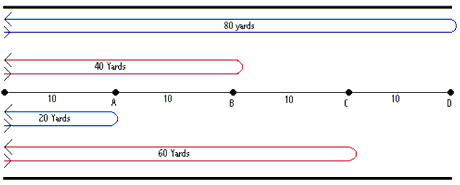
The aerobic and anaerobic running components are spread out over three days during each week of the program. During the 6 weeks, training will consist of going for runs, completing a 200 yard shuttle course, completing 50 metre and 25 metre sprints, and completing the 20 metre shuttle run used in the PREP.
It should be noted that the distances covered for each of the runs are targets to try and achieve. You must remember that in order to receive maximal aerobic gains you must work at approximately 80% of your maximal heart rate for the duration of the run. If you are not capable of completing the required distance of each run in the allotted time at least make sure that the intensity of the exercise makes you work in your target heart rate zone for the full duration of the run.
In order to calculate your target heart rate, or intensity of exercise, use the following formula:
|
(220-age) x 0.80 (80%)
|
|
Example: The target heart rate for a 25-year old individual would be:
|
|
(220-25) x 0.80 = 156 beats per minute
|
When completing each 200-yard shuttle run try your best to complete each cycle in the allotted amount of time. If you cannot do so, make sure you at least finish each cycle without altering the time allotted for the rest period.
To complete each cycle you must continuously run from the:
- Start to A and back to the Start
- Start to B and back to the Start
- Start to C and back to the Start
- Start to D and back to the Start
When completing the speed sprints you must make sure to cover the full distance (25 metres or 50 metres). Do not slow down before passing the finish line. Also, try to be as consistent as possible in relation to the intensity of each sprint (i.e. 70% maximum effort). Make sure that each sprint is run at a pace as similar as possible to the one before.
Workout Chart
Print out a copy of the work out chart so you can follow it each day of the week. Print out a copy of the calendar (above link) to keep you motivated. Put a check mark beside each day you have completed.
Preparation home