

Police services across the United Kingdom require a working
understanding of the English language. It is imperative to
be able to express yourself succinctly and be able to filter, analyze and
organize any information given to you into a legible report.
At the assessment centre you will be required to perform two written exercises. You are only permitted
to make 10 spelling mistakes in total, so use words that you are confident you know how to spell. If you are asked to write a memo, report, proposal or letter,
remember to keep in mind the core competencies that police services are seeking. Below is a list of them.
|
Responsibility
|
The willingness to accept personal responsibility for situations that you had control over and any decisions that you have made with either positive or negative consequences. Acts with a high degree of integrity and honesty. |
|
Analytical Thinking
|
The ability to analyze situations and events in a logical way, and to organize the parts of a problem systematically. |
|
Self - Confidence
|
A belief in your capabilities and recognition of personal limitations. |
|
Communication
|
You must have the skills to effectively communicate using listening skills and verbal and written communications skills. |
|
Flexibility / Valuing Diversity
|
As a police officer, you will have to work with a wide cross-section of the community that includes diverse backgrounds, cultures and socio-economic circumstances. You must have the ability to adapt your approach to each situation. |
|
Self - Control
|
Policing can be extremely stressful. You must establish that you can control your emotions actions when provoked. |
|
Relationship Building
|
Developing contacts and relationships both within and outside the police service is extremely valuable. |
|
Achievement Orientation
|
You must demonstrate a desire for continuous improvement in service and accomplishments. |
|
Information Seeking
|
The ability to seek out and analyze information from various sources before making decisions. |
|
Concern for Safety
|
The ability to exercise caution in hazardous situations in order to ensure safety to self and others. |
|
Assertiveness
|
The capacity to use authority confidently and to set and enforce rules appropriately. |
|
Initiative
|
Demonstrated proficiency to be self-motivated and self-directed in identifying and addressing important issues. |
|
Cooperation
|
Willing to act with others by seeking their input, encouraging their participation and sharing information. |
|
Negotiation / Facilitation
|
The ability to influence and persuade others by anticipating and addressing their interests and perspectives. |
|
Work Organization
|
The ability to develop and maintain systems for organizing information and activities. |
|
Community Service Orientation
|
Proven commitment to helping or serving others. |
|
Commitment to Learning
|
Demonstrated pattern of activities that contribute to personal and professional growth. |
|
Organization Awareness
|
A capacity for understanding the dynamics of organizations, including the formal and informal cultures and decision-making processes. |
|
Developing Others
|
Commitment to helping others improve their skills. |
Testing Instructions
You will be given 60 minutes to perform each test. The count begins as soon as the page is displayed. The page will automatically close when the time is up. Make sure that you have enough time to complete the test before you start. There are no pauses in the test.
You will be required to have a pencil and paper on hand to write out your answers. Remember that when you apply to the police services you will be judged on the legibility of our handwriting. Your marker must be able to read your report. You are allowed to take notes to organize your information before beginning the report.
Materials Allowed
Only a pencil and paper are allowed in the test. Dictionaries, thesauruses, and electronic devices are not permitted.
Completion
Upon completion of each practice exam you will be shown a sample answer written by a police officer. Remember that these are just examples, and that your answer does not have to be identical. Pay attention to the structure and how the information is presented. Review the material below before taking any practice written exams.
Report Intro
Many police services will ask you to write a report based on a series of information. They are assessing your ability to sort through data, reach a logical conclusion and present the information in a clear, coherent manner. There are several things you must keep in mind while performing this exercise.
|
There will be irrelevant information included in the question.
|
|
The information may be presented in random order.
|
|
You will have to analyze and recreate the event concisely and clearly.
|
|
You will be under time pressure.
|
Writing Process
Information Gathering
As you are going through the information, you should be identifying relevant information and sorting it. There are six basic questions that you should be addressing while you are writing your report.
|
|
If possible "why" should be included. But be careful not to invent details in the report
While reading through the report, pull out information which may seem relevant. Sort it into categories and make notes. Information should be grouped inot the following categories.
|
|
Depending on the scenario, there are other categories that may be more relevant.
Report Writing
As a test applicant, and later as an officer, always follow the KISS rule. This is always essential. Police reports are factual, relevant, and clear. Below is a list of suggestions on how to write your report.
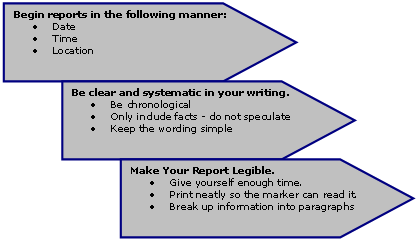 |
Practice writing as many reports as you can. Observe the formats used on this Internet site.
Marking Components
You will be marked on the following four components:
1) Comprehension - You must demonstrate that you understand what happened in each scenario. This will involve puzzle-solving skills.
2) Conclusions - You must reach a logical conclusion to the events that transpired. You will have to interpret the data and make a decision as to what must have happened.
3) Technical Writing - Your grammar and spelling must be correct.
4) Penmanship - Markers have to be able to read your writing without difficulty.
5) Competencies - Where appropriate incorporates decisions and descriptions that take into account the competencies sought by police services.
Testing Options
Written Exercises for the Assessment Centre


 |
Additional Writing Exercises


|